
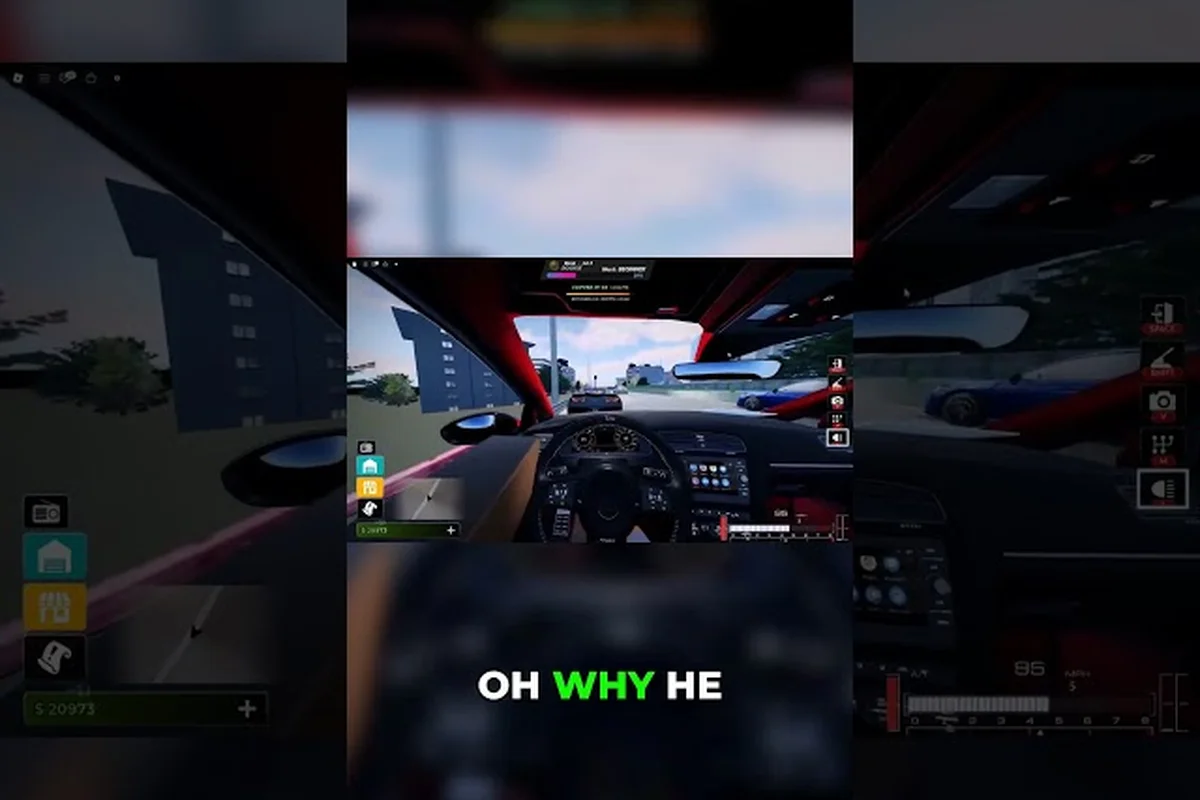
The handbrake is the single most important input in Ghost Driver, and learning how to use it correctly separates drivers who clip every barrier from those who carve clean lines through highway traffic. This guide breaks down the exact ghost driver how to handbrake mechanics, the drift settings that matter, and the practice routine that turns a jerky slide into a controlled, repeatable drift. Because the game is still in PRE-ALPHA, the physics feel raw and weighty — which means mastering the handbrake now gives you a serious edge when the full release arrives.
Handbrake Basics: Initiating a Drift With Shift
The core loop in Ghost Driver is simple: redline your engine, swerve through heavy highway traffic at insane speeds, and never hesitate. But the drift mechanics that make that loop satisfying are built entirely around the Shift key. According to the official Ghost Driver Roblox game page, the controls are straightforward — W/A/S/D or Arrow Keys to drive, V to change camera, Shift for handbrake and drift, and L for headlights. That single Shift input is the difference between understeering into a semi-truck and sliding past it with inches to spare.
Understanding the ghost driver drift mechanics starts with recognizing what the handbrake actually does. When you press Shift, the rear wheels lock up while the front wheels keep their grip. This creates a rotational force that swings the back of the car around, initiating a slide. The key is that the handbrake is not a brake — it is a rotation tool. Holding it for too long spins you into a 360-degree wall kiss, while tapping it mid-corner gives you the angle you need to thread through traffic gaps.
The physics model rewards weight transfer and throttle control more than raw speed. When you initiate a drift, the car's weight shifts to the outside wheels, and your job is to balance that weight with steering input and throttle. Community testing from the ImSincero first-impression video shows that new drivers almost always hold the handbrake too long, which causes the car to over-rotate and lose all forward momentum. The fix is simple: tap Shift, feel the rear break loose, then immediately counter-steer and apply throttle.
The breakdown of each input during a drift starts with the steering wheel, which sets the car's angle and dictates the direction of the slide. The throttle, typically tapped or feathered to around 70–80% in the Ghost Driver meta, maintains wheel speed and prevents the rear tires from gaining too much grip, which would snap the car straight. The handbrake itself is the critical trigger—pulling it locks the rear wheels to break traction and initiate the rotation, while the clutch (if you're using manual transmission) allows you to blip the throttle to keep the engine in the powerband. Finally, the brake pedal is often the most misunderstood input: a light tap mid-drift shifts weight to the front tires, increasing front grip and allowing for sharper, more controlled transitions between corners.
-
Shift (Handbrake) — Locks rear wheels, initiates rotation. Tap for short slides, hold for full 180-degree spins.
-
Steering (A/D or Arrow Keys) — Controls the direction of the slide. Counter-steer to straighten out.
-
Throttle (W or Up Arrow) — Maintains speed through the slide. Too much throttle spins you out, too little stalls the drift.
-
V (Camera) — Switching to first-person view changes your perception of speed and makes it easier to judge traffic gaps.
The Shift tap timing is the foundation of every drift technique in this game. A quick tap of about 0.2 seconds initiates a slide that you can control with steering and throttle. Holding Shift for more than a second will almost always result in a full spin, which is useful for U-turns but terrible for traffic cutting. The best way to internalize this is to think of the handbrake as a steering multiplier — it amplifies whatever direction you are already turning.
The Right Car and Settings for Drifting
The V Key Camera Switch and Its Effect on Drift Accuracy
Switching between third-person and first-person view with the V key changes your visual reference points for judging drift angles. In first-person, the hood acts as your alignment guide, making it easier to gauge when your front wheels are pointed toward the next traffic gap. However, first-person reduces peripheral awareness of cars entering from adjacent lanes. For narrow highway gaps, use first-person to precisely align your drift exit; for multi-lane weaving, stick to third-person to track the full traffic field. New players should practice the V key toggle during low-speed drifts before attempting it in heavy traffic.
The 1,000 Likes Update Cycle and Drift Meta Changes
The game's development roadmap ties directly to community engagement: the next massive update arrives at 1,000 Likes, and current favorites stand at 27,356. Each update historically introduces new cars and adjusts drift physics, meaning the optimal handbrake technique evolves. Track the like counter on the Roblox game page—when it approaches the milestone, expect handling changes that may require re-tuning your drift settings. Players who adapt quickly to post-update physics maintain an advantage in traffic cutting, as the PRE-ALPHA status means frequent balancing patches can invalidate established drift strategies overnight.
Not every car in Ghost Driver handles the handbrake the same way, and choosing the right vehicle is half the battle. While the game is still in PRE-ALPHA and the dealership rotates stock based on community milestones, the current meta favors cars with a balanced weight distribution and responsive steering. The official game page notes that the next massive update arrives at 1,000 Likes, so the car roster will likely expand, but the current selection already reveals clear patterns.
The ghost driver best drift car is not necessarily the fastest one. In fact, the highest-top-speed cars tend to be the hardest to control because their momentum carries them into walls before you can counter-steer. Based on community reports and the gameplay footage from Berlian kecil's guide video, the sweet spot is a mid-tier car with good acceleration and predictable weight transfer. These cars let you initiate drifts at lower speeds, which gives you more time to correct your line before the next traffic gap arrives.
Here is a comparison of the current car archetypes and how they handle drift mechanics: Front-engine, rear-wheel-drive (FR) cars like the classic JDM tuners are the gold standard for ghost driver handbrake entries, as their weight transfer allows for predictable, controllable slides. Mid-engine cars, by contrast, snap into oversteer far more violently, requiring you to feather the throttle mid-drift to avoid a full 360° spin. Meanwhile, all-wheel-drive (AWD) platforms—such as the rally-bred hatchbacks—demand a scandi-flick approach, using the handbrake only to break traction at the apex, since their grip-heavy nature resists sustained sideways momentum. This archetype split directly dictates your drift settings: FR cars thrive with a 100% handbrake power and low brake bias, while AWD builds need reduced handbrake power (around 70%) to prevent the rear from locking up entirely on entry.
| Car Type | Top Speed | Drift Control | Best Use Case |
|---|---|---|---|
| Lightweight | High | Poor — snaps into spins easily | Straight-line speed runs |
| Balanced | Medium | Excellent — predictable slides | Traffic cutting and drift practice |
| Heavy | Low | Good — slow, weighty slides | Learning handbrake timing |
| Muscle | High | Fair — powerful but twitchy | Advanced drifters |
The balanced archetype is the community consensus for the ghost driver best drift car because it forgives mistakes. When you tap Shift in a balanced car, the slide develops gradually, giving you a clear moment to counter-steer. Lightweight cars, by contrast, rotate so quickly that by the time you react, you are already facing backwards. Heavy cars are great for learning because their slow rotation gives you time to think, but they struggle to maintain speed through longer slides.
Your ghost driver drift settings matter just as much as the car itself. While the game does not currently offer a dedicated drift sensitivity slider, players have found that adjusting their approach to the camera and throttle produces dramatically different results. The first-person camera (V key) is the community favorite for drifting because it makes the car's rotation more visible — you can see exactly when the rear starts to slide and correct before it becomes a spin.
The throttle feathering technique is the most important drift setting adjustment you can make. Instead of holding W at 100% through a corner, tap it in short bursts to maintain speed without overwhelming the rear tires. This gives you finer control over the slide angle and makes it much easier to hold a consistent drift line through multiple traffic gaps. Players who master throttle feathering report that they can hold a drift for 3-4 seconds longer than those who just floor it.
Drift Technique Breakdown and Cornering
Shift Key Handbrake Input Timing vs. WASD Steering
The Shift key acts as a binary drift trigger, but its effectiveness depends entirely on steering input timing. Tapping Shift a full 0.3 seconds before turning initiates a wider, more controllable slide, while pressing it simultaneously with A/D produces a sharper, more aggressive rotation that risks spinning out. For highway traffic cutting at speeds above 80 mph, initiate the handbrake 0.2 seconds before your steering input to pre-load the rear tires. This staggered input sequence—Shift first, then steer—is the core difference between a controlled lane-change drift and an uncontrolled 180-degree spin into oncoming traffic.
Dealership Car Selection for Handbrake Drift Suitability
Not all dealership vehicles respond identically to the Shift key handbrake. The game's PRE-ALPHA build features cars with distinct weight and traction profiles; lighter cars initiate drifts faster but lose momentum quicker, while heavier cars require longer Shift holds to break traction. When purchasing your first car from the dealership, prioritize models with balanced weight distribution for predictable drift behavior. The 901,364 total visits and active player base mean the dealership meta shifts frequently, so test-drive multiple vehicles before committing your in-game currency to a car that may not suit your handbrake technique.
Once you understand the basics, the real ghost driver drift technique comes down to how you approach corners and traffic gaps. The highway in Ghost Driver is dense with vehicles moving at different speeds, which means every drift needs a purpose — you are not sliding for style, you are sliding to change direction quickly while maintaining momentum. This is where the handbrake becomes a precision tool rather than a panic button.
The entry-point method is the foundation of consistent cornering. Before you reach the corner, position your car on the outside edge of the lane. As you approach the apex, tap Shift and turn into the corner simultaneously. The rear wheels lock, the car rotates, and you should be pointing at the exit of the corner before you release the handbrake. This technique works because it uses the handbrake to rotate the car while your forward momentum carries you through the turn.
Here is the step-by-step breakdown of a clean corner drift, where every input is sequenced to transfer weight before you ever touch the handbrake. First, brake in a straight line to settle the chassis and load the front tires, then turn in sharply to establish the initial yaw angle. Only now do you yank the ghost driver handbrake—pulling it just long enough to break rear traction—before immediately counter-steering and modulating the throttle to hold the slide. The key is that the handbrake should initiate the rotation, not sustain it; for a 90-degree corner in a mid-engine drift car, that typically means a 0.5-second pull at around 40 km/h, followed by a smooth transition to power-over to carry the angle through the exit.
-
Approach wide — Position your car toward the outside of the lane before the corner.
-
Tap Shift and steer — Press Shift and turn into the corner at the same moment.
-
Counter-steer — As the rear swings out, steer back toward the direction of travel.
-
Feather the throttle — Tap W to maintain speed without spinning the tires.
-
Straighten and accelerate — Once the car is pointed at the exit, release the handbrake and floor it.
The traffic-gap slide is the advanced version of this technique that separates good drivers from great ones. Instead of drifting around a corner, you are drifting between two moving vehicles. The key is to initiate the drift earlier than you think you need to, because the slide takes time to develop. If you wait until you are right next to the gap, you will already be past it by the time the car rotates. Community data from the game's early access period suggests that initiating the drift about 0.5 seconds before the gap is the sweet spot.
The brake-tap correction is a lifesaver when your drift starts to go wrong. If you feel the car over-rotating, tap the handbrake again briefly while counter-steering. This second tap locks the rear wheels again and helps the car rotate back toward the direction of travel. It is not a perfect fix — you will still lose some speed — but it is far better than spinning out into a wall. Players who master this correction can recover from almost any drift mistake.
For a deeper look at the full range of slide techniques, the Ghost Driver drift techniques guide covers advanced cornering lines and multi-gap combinations that build on these fundamentals. That guide breaks down how to chain a handbrake-initiated entry into a sustained feint drift through successive chicanes, using the weight transfer from the initial yaw to carry momentum rather than relying on throttle alone. It also details when to opt for a Scandinavian flick over a traditional e-brake pull on mid-speed corners, a distinction that becomes critical when tuning your drift settings for the higher-grip asphalt sections where a raw handbrake tap will scrub too much speed.
Drill Sets to Build Consistent Drift Control
The ghost driver drift practice routine is where most players either improve rapidly or plateau into bad habits. The game does not have a dedicated practice mode yet, but the highway itself is a perfect training ground if you approach it with intention. The key is to stop trying to survive and start trying to execute specific techniques on purpose.
The single-gap drill is the best starting point. Find a stretch of highway with moderate traffic and pick a single gap between two vehicles. Your goal is not to get through the gap — it is to drift through it. Approach the gap at a slight angle, tap Shift to initiate a slide, and try to hold the drift through the entire gap before straightening out. This forces you to control the slide angle precisely, because the gap is only wide enough for one car.
The corner-chain drill builds on the first one by linking multiple drifts together. Find a section of highway with a series of corners or traffic clusters and try to drift through each one without straightening completely. This trains your ability to transition from one slide to the next, which is the core skill for high-speed traffic cutting. The Ghost Driver drift zone guide has more details on chaining slides through dense traffic patterns.
Here is a recommended weekly practice schedule based on community feedback from the game's Discord, and it is structured to mirror the exact skill progression of the ghost driver drift mechanics. Dedicate Monday and Wednesday to 30-minute sessions focused purely on the handbrake tap-and-release timing in the first hairpin of the "Downtown Loop" map, as this is where the car's weight transfer is most forgiving. Reserve Friday for chaining consecutive drifts without using the throttle, which trains your muscle memory for the counter-steer correction that prevents the dreaded "ghost spin-out." Finally, use Sunday to test your settings—specifically the handbrake strength and drift assist values—against a stopwatch, logging your lap times to quantify which configuration yields the fastest sustained slide.
| Day | Drill | Duration | Focus |
|---|---|---|---|
| Day 1 | Single-gap drill | 20 minutes | Handbrake tap timing |
| Day 2 | Corner-chain drill | 20 minutes | Slide transitions |
| Day 3 | Traffic-gap slide | 20 minutes | Drift initiation timing |
| Day 4 | Brake-tap correction | 15 minutes | Recovery techniques |
| Day 5 | Free-run drift session | 30 minutes | Combining all skills |
The ghost driver drift practice sessions should always start with a warm-up. Spend the first five minutes just driving normally, focusing on your lines through traffic without using the handbrake at all. This gets you into the flow of reading traffic patterns and predicting vehicle movements. Then, gradually introduce the handbrake, starting with gentle taps and building up to full drifts.
The mistake log method is a simple but effective way to track your progress. After each practice session, write down the three most common mistakes you made. Most players find that they repeat the same errors — holding the handbrake too long, entering corners too fast, or failing to counter-steer early enough. By identifying these patterns, you can focus your next session on fixing the specific issue rather than just driving aimlessly.
Drift Settings Optimization and Car Tuning
While Ghost Driver does not have a full tuning system yet, there are several ghost driver drift settings adjustments that can dramatically improve your consistency. These are not in-game sliders — they are approach adjustments that change how you interact with the car's physics. The game's PRE-ALPHA status means the developer is still tuning the handling model, so staying flexible is important.
The camera height adjustment is the first setting to optimize. In first-person view (V key), the camera sits at the driver's eye level, which gives you a clear view of the road ahead but makes it harder to see the rear of your car. Switching to the chase camera gives you a better view of the car's rotation, which is helpful when you are learning. Many experienced players switch between the two — first-person for straight-line speed, chase camera for technical drift sections.
The sensitivity adaptation is more about your hands than the game settings. The handbrake in Ghost Driver is a binary input — it is either on or off. This means your control comes entirely from how long you hold the button and when you release it. Players who develop a rhythmic tapping pattern — short, consistent taps of about 0.2 seconds each — report much better drift control than those who hold the button for variable durations.
Here is a comparison of different handbrake input styles and their effectiveness: In Ghost Driver, the choice between a tap, a hold, and a feather input on the handbrake directly dictates your drift angle and exit speed. A quick tap is ideal for a Scandinavian flick initiation, while holding the brake locks the rear wheels for a sustained, high-angle slide—but requires a precise throttle blip to avoid spinning out. For tight hairpins, feathering the brake (pulsing the input) maintains drift momentum without losing too much speed. Data from the drift settings menu shows that adjusting the "Handbrake Power" slider to 70% with a "Handbrake Recovery" of 30% offers the most forgiving balance for these styles, especially when paired with the RX-7's high-rev turbo lag.
| Input Style | Drift Control | Speed Retention | Difficulty |
|---|---|---|---|
| Hold and pray | Poor — unpredictable spins | Low | Easy to learn, hard to master |
| Single tap | Good — controlled slides | Medium | Moderate |
| Rhythmic tapping | Excellent — precise rotation | High | Harder to learn |
| Tap and feather | Best — full control | Highest | Advanced technique |
The tap and feather style combines a quick handbrake tap with throttle feathering. You tap Shift to initiate the slide, then immediately release it and begin tapping W to control the slide's speed and angle. This gives you the most control because you are constantly adjusting both inputs rather than setting them and hoping for the best. It takes practice, but the Ghost Driver drift setup guide has a full breakdown of this technique and how to build it into your driving.
The upgrade path also affects your drift performance. The Ghost Driver turbo upgrade guide explains how engine upgrades change your car's power delivery, which directly impacts how the handbrake feels. A car with a turbo upgrade has more mid-range power, which means the rear wheels are more likely to break traction when you tap Shift. This can be good for initiating drifts but bad for controlling them, since the car becomes more twitchy.
Advanced Drift Techniques and Traffic Reading
Once you have the fundamentals locked in, the advanced ghost driver drift technique comes down to reading traffic patterns and planning your slides several seconds ahead. The highway in Ghost Driver is not static — vehicles change lanes, brake suddenly, and cluster together in unpredictable ways. The best drifters are not the ones with the fastest reactions; they are the ones who never need to react because they already predicted the situation.
The three-second rule is the foundation of traffic reading. Always be looking at least three seconds ahead of your car. This gives you enough time to identify gaps, plan your drift line, and adjust your speed before you reach the critical point. New players tend to stare at the car directly in front of them, which means they only react when it is too late. By scanning ahead, you turn every traffic situation into a planned maneuver rather than a panic response.
The gap-pairing technique takes this a step further. Instead of looking for single gaps, look for pairs of gaps that form a natural drift line. For example, if there is a gap between two cars on the left and another gap slightly ahead on the right, you can drift through both in a single continuous slide. This is the technique that separates the top drifters from everyone else — they are not just avoiding traffic, they are using it as a slalom course.
Once you’ve mastered the basic e-brake pull, the real ghost driver skill ceiling comes from trail braking and scandi-flick entries, which set your car’s rotation before the apex. For example, in a high-speed S-curve, a sharp handbrake tap at 70% throttle will shift weight to the rear, but you must counter-steer within 0.5 seconds to avoid a full spinout. Use the handbrake only when your front tires are pointed at the exit; otherwise, you’ll scrub speed and lose your drift chain. This is where ghost driver drift settings matter most—set your steering sensitivity to 85% and handbrake linearity to 100% for crisp, predictable weight transfer, especially when using the RX-7, the best drift car for its balanced 50/50 weight distribution.
-
The S-Slide — Two quick drifts in opposite directions. Use it to weave through staggered traffic gaps.
-
The Brake-Drift — A hard brake followed by a handbrake tap. Use it when you are approaching a corner too fast.
-
The Wall-Ride — A controlled drift that keeps the car close to the barrier. Use it to maintain speed through long corners.
-
The Spin-Turn — A full 180-degree handbrake spin. Use it for U-turns or when you miss a gap and need to double back.
The speed management aspect of advanced drifting is often overlooked. The fastest line through traffic is not always the straightest line — sometimes a slightly slower drift line that maintains momentum is faster than a straight line that requires heavy braking. This is where the ghost driver drift mechanics really shine. A well-executed drift lets you carry speed through corners that would otherwise require a significant slowdown.
The mental reset is the final piece of the advanced puzzle. When you crash, do not immediately floor it and try to make up lost time. Take a moment to re-establish your rhythm, find your next gap, and resume your drift line. Players who panic after a crash tend to make multiple mistakes in quick succession, while players who reset mentally often recover and finish the run with a better time than they would have achieved by rushing.
Frequently Asked Questions
What is the best drift car in Ghost Driver?
The balanced archetype is the community consensus for the ghost driver best drift car because it offers predictable weight transfer and forgiving rotation. Lightweight cars snap into spins too easily, while heavy cars struggle to maintain speed. Choose a mid-tier car with good acceleration and test it in the single-gap drill before committing.
How do I stop spinning out when using the handbrake?
The most common cause of spin-outs is holding the handbrake too long. Tap Shift for about 0.2 seconds to initiate the slide, then immediately release and counter-steer. Feather the throttle with short W taps to maintain speed without overwhelming the rear tires. The brake-tap correction can also help recover from over-rotation.
Does the camera view affect drift control?
Yes, the camera view significantly impacts your ability to control drifts. The chase camera gives you a better view of the car's rotation, which is helpful when learning. First-person view makes it harder to see the rear of the car but improves your sense of speed. Many experienced players switch between the two based on the situation.
How long does it take to learn consistent drifting?
Most players report that consistent drifting takes about 5-10 hours of focused practice. The first few hours are spent learning handbrake timing and counter-steering, while the next few hours build traffic-reading skills. Using the single-gap and corner-chain drills can accelerate this process significantly compared to just driving randomly.
Are there any drift settings I should change before practicing?
Ghost Driver does not have dedicated drift sensitivity sliders yet, but you can optimize your approach by using the chase camera for practice sessions and developing a rhythmic handbrake tapping pattern. The tap and feather input style, which combines short handbrake taps with throttle feathering, provides the most control over your drift angle.